
Plateaus are elevated flat-topped landforms that rise sharply above the surrounding terrain and are formed through geological processes.
- Also known as Tableland.
- Covering about One-Third of the Earth’s area.
- Can be old or young.
- Rich in Mineral resources.
Formation of Plateaus
Thermal Formation
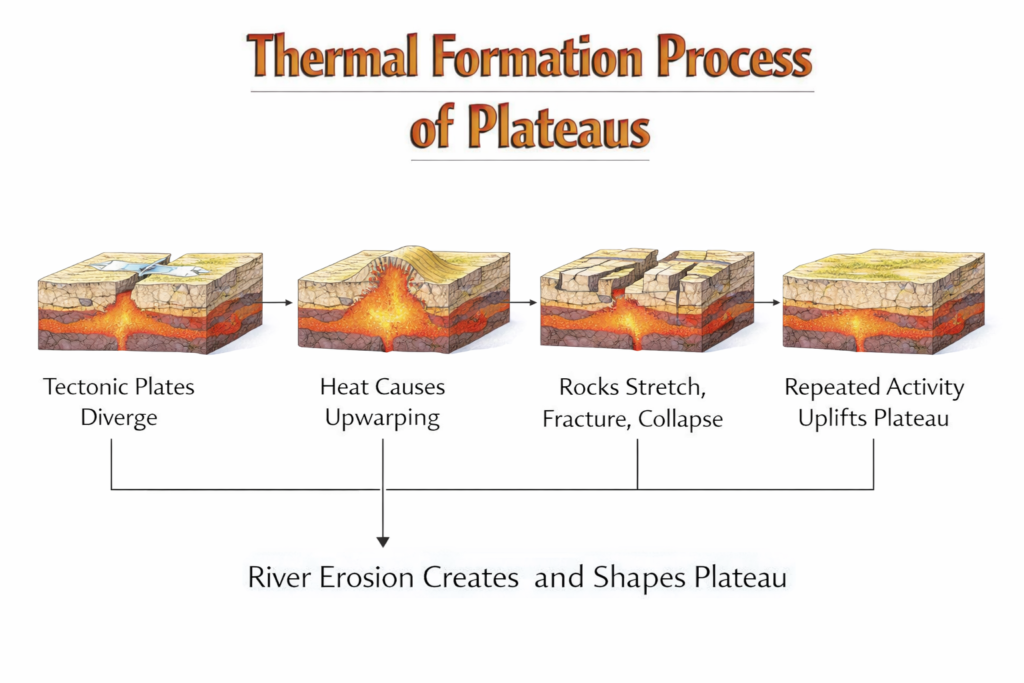
- As a result of the upward movement of magma, intense magmatic pressure is exerted. This pressure causes the crust to bend, but the magma does not fully erupt onto the surface.
- Consequently, this uplift can lead to elevated flat areas known as plateaus.
- Examples :- Massif Central of France and the Ethiopian Highlands of Africa.
Crustal Shortening
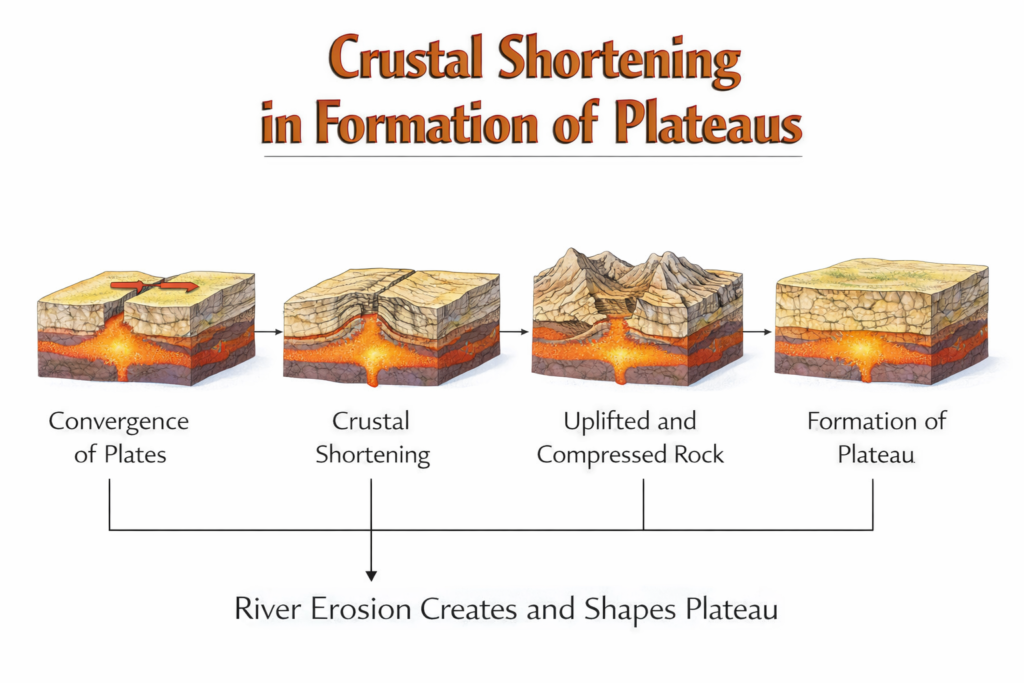
- Convectional currents pushing crust towards each other can lead to one plate undergoing subduction while another plate rises.
- This rising plate can then form a plateau.
- Example :- Tibetan Plateau.
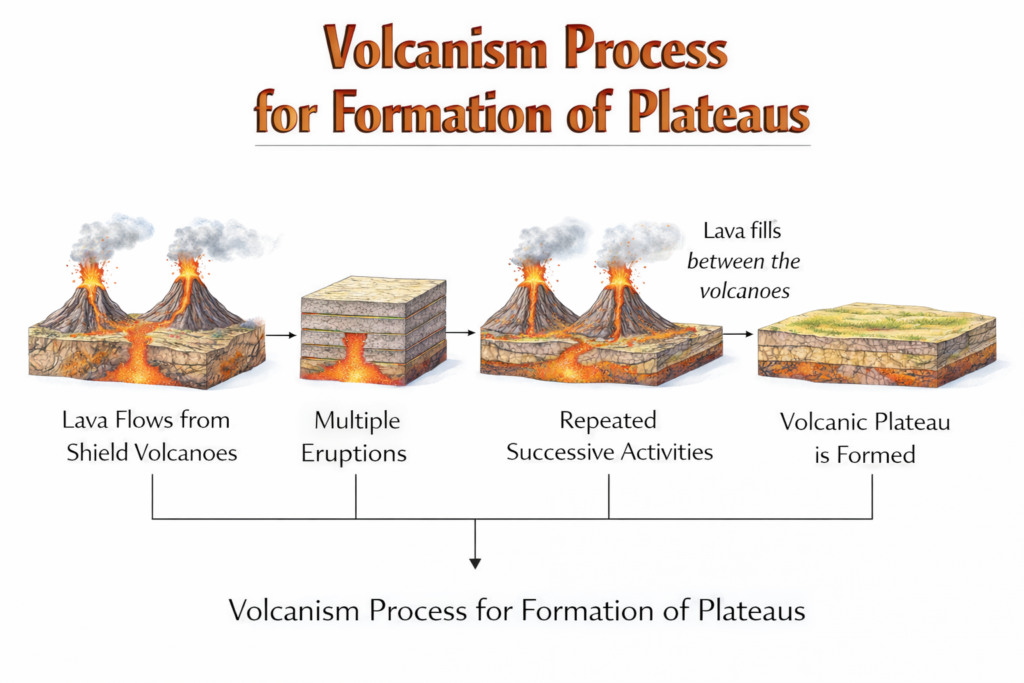
Volcanism
- Plateaus can form due to volcanic activity when lava flows from eruptions accumulate over time, gradually building up the land surface.
- As successive layers of lava solidify, they create a flat or gently sloping elevated area known as a plateau.
- Examples :- Deccan Plateau, Siberian Plateau, Columbia Plateau, etc.
Types of Plateaus
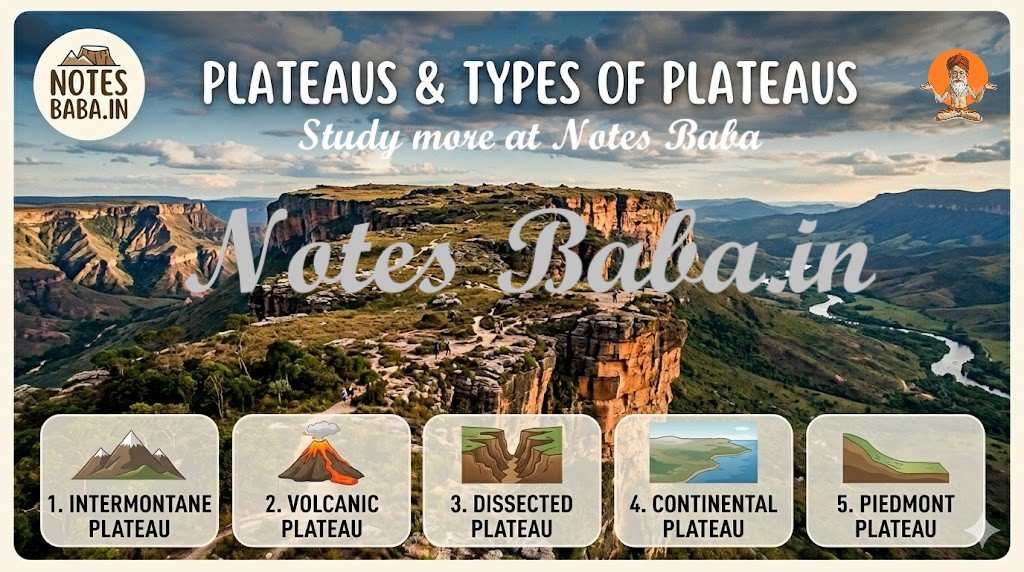
Based on their formation mechanisms, plateaus are divided into several types – Peidmont, Intermontane, Volcanic, Dissected, Continental, Glacial and Dome-Shaped.
Piedmont Plateaus
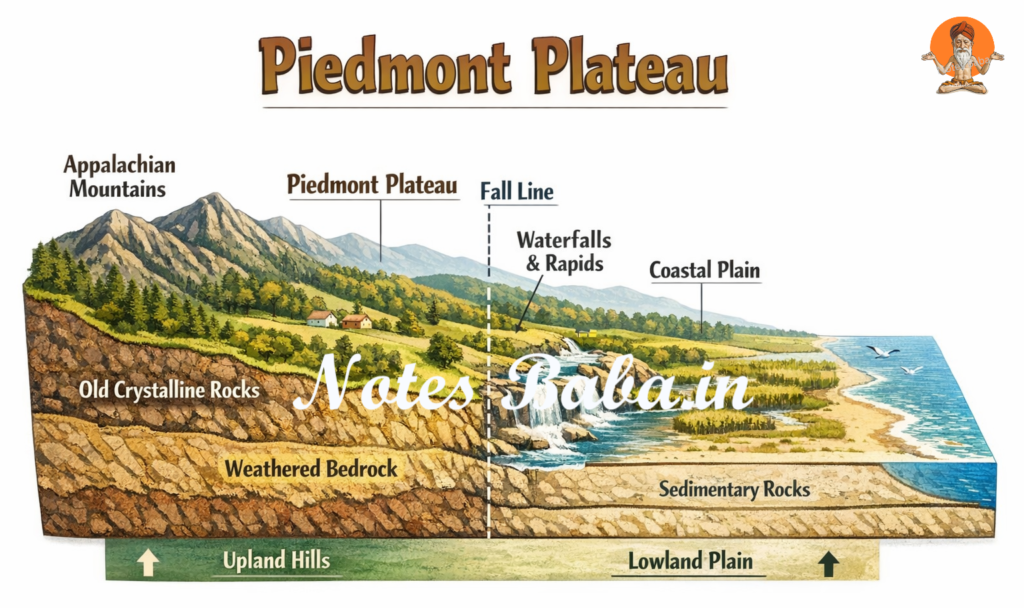
- The word ‘Piedmont‘ means ‘foot of a mountain‘. It is a type of plateau which is located at the foot of a mountain.
- Locked or Surrounded by the mountains on one side and on the other side by ocean, sea or plains.
- Formed by the continuous deposition of eroded materials from the nearby mountains.
- Rich in Mineral deposits and fertile soil.
- Having Slope towards the plains and uplifted towards the mountains.
- Example :- Patagonia Plateau (South America), Appalachian Plateau (North America), Malwa Plateau (India) etc.
Intermontane Plateaus
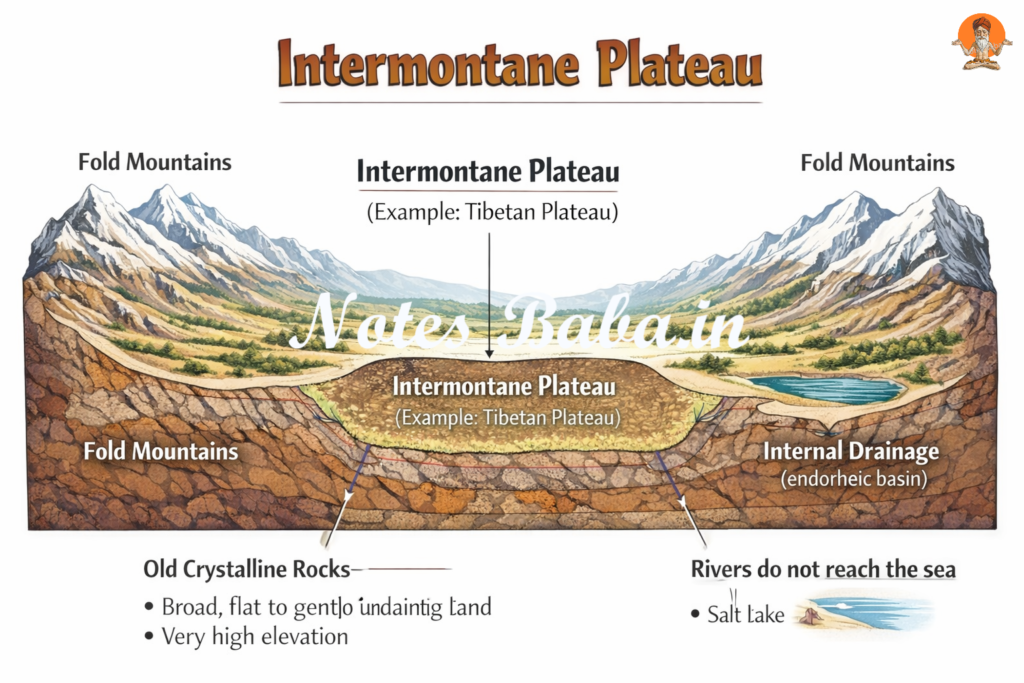
- Uplifted region surrounded by the two or more hills and mountains.
- Formed by the uplift of Earth’s crust due to tectonic activity.
- Due to this upliftment, it becomes one of the highest plateaus on the earth.
- Have arid or semi-arid climates with limited vegetation.
- Have broad, flat surfaces and may contain large valleys, basins or dry river beds.
- Examples :- Bolivian Plateau (South America), Tibetan Plateau (surrounded by Himalayas and Kunlun Range) etc.
Volcanic Plateaus
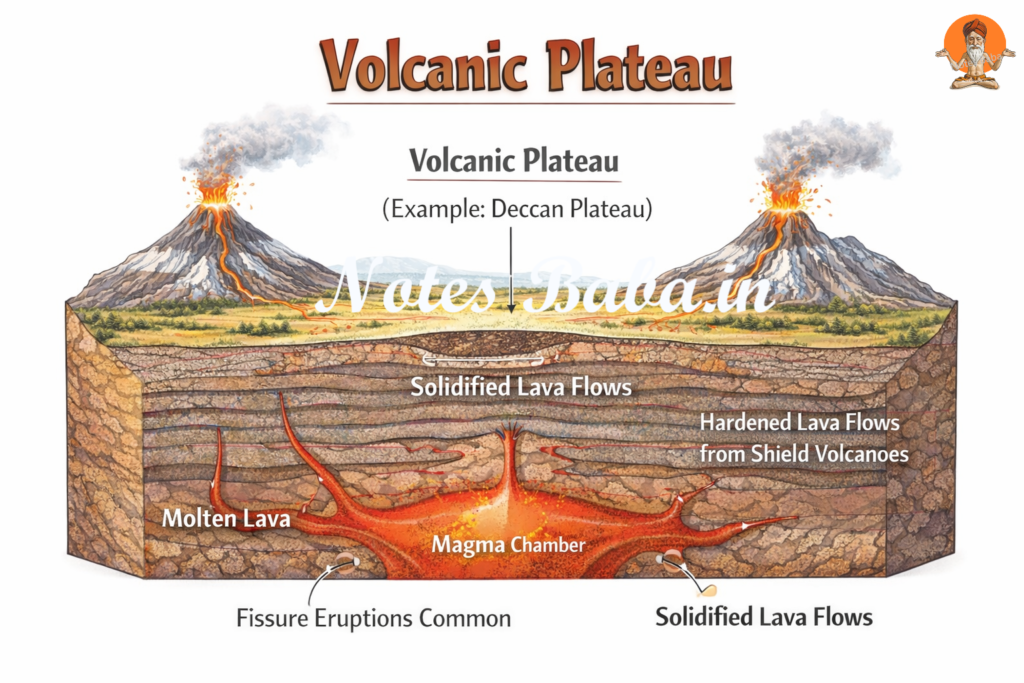
- Large elevated flat landform which is formed by the flood basalt or basaltic lava.
- Formed due to repeated volcanic eruptions from cracks or fissures over large period of a time.
- Covers a large distance, forming a sheet.
- Formed near the Continental Margin or Volcanic Hotspot.
- Successive layers of basaltic lava cools and harden, forming a large elevated land.
- Associated with the shield volcanoes or fissure eruptions.
- Have very fertile soil for agriculture.
- Example :- Deccan Traps (India), Columbia Plateau (USA) etc.
Dissected Plateaus
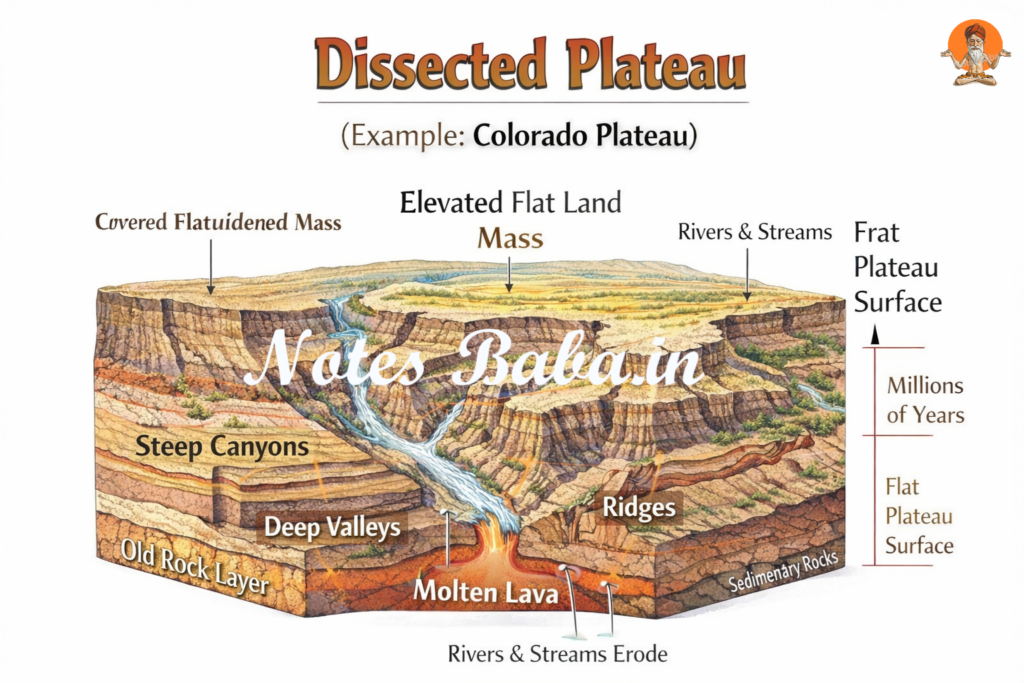
- It is evolved to plateau by the denudation process.
- Uplifted by the tectonic forces and after upliftment, it becomes subject to erosional forces.
- Have steep slopes, and sharp ridges from where rivers cut through the elevated surfaces.
- Due to erosion by rivers, deep and narrow valleys or gorges are formed.
- Rivers or streams form dendritic (tree like) drainage patterns.
- Example :- Colorado Plateau (USA) etc.
Continental Plateaus
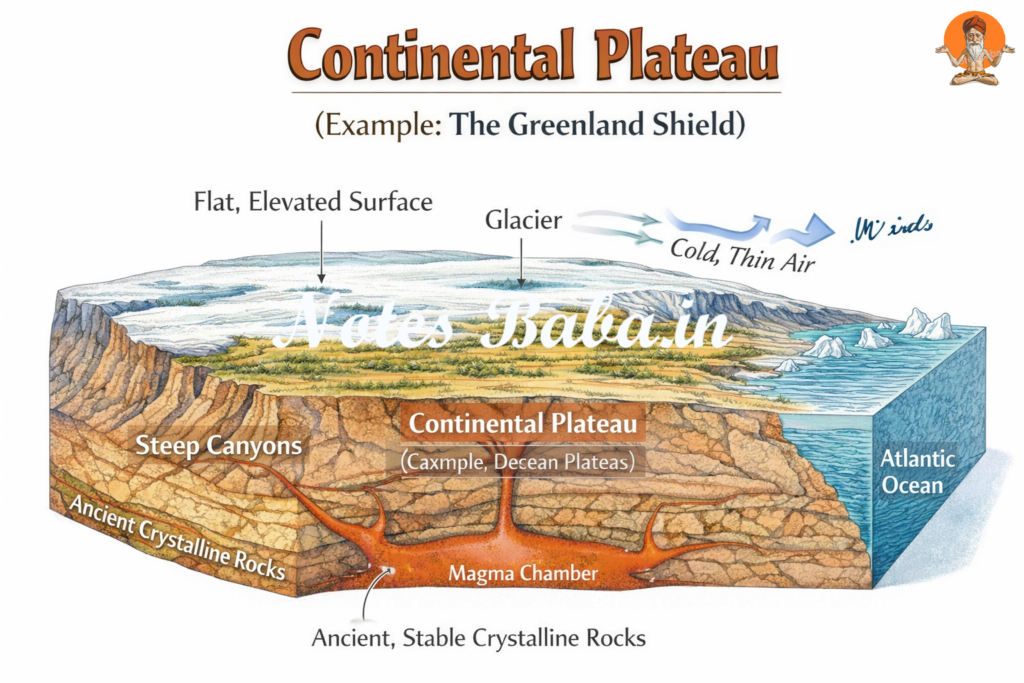
- Large elevated flat landmass formed on Continental Crust.
- Also called Shield regions.
- Boarded by the plains or seas.
- Formed due to tectonic processes.
- Part of large and stable continental part.
- Contrast with steep and rugged topography of fold mountains.
- High elevations, and are several thousands meters above the sea level.
- Have little siesmic or volcaninc activity.
- Made of very old, stable crystalline rocks.
- Example :- Antarctica Plateau (East Antarctica), Maharashtra Plateau (India) etc.
Glacial Plateaus
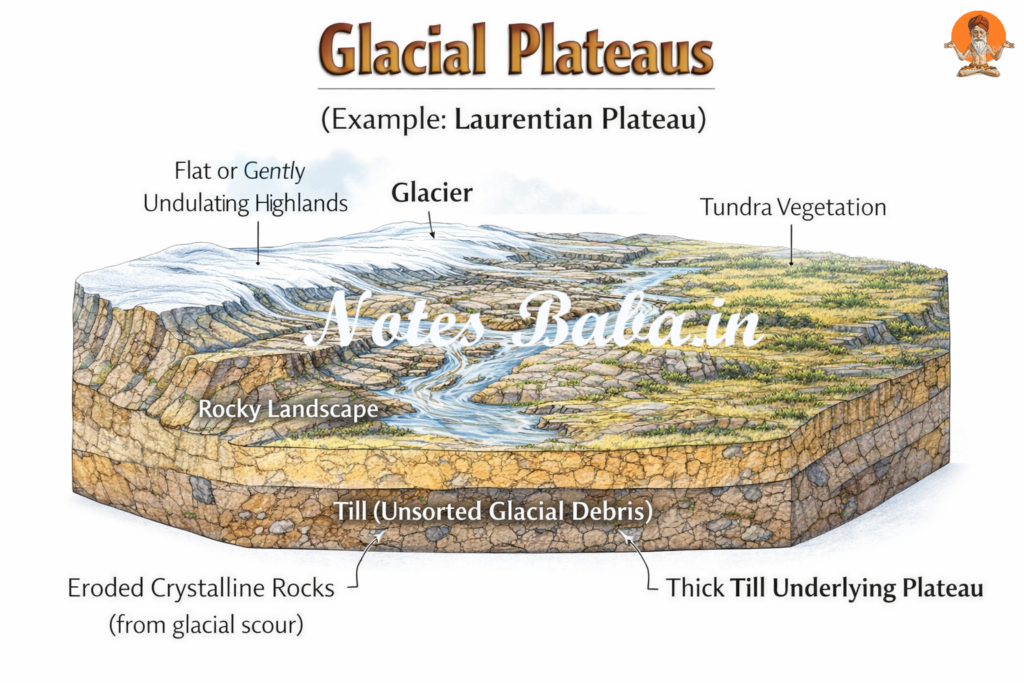
- Formed by the Glacial actions.
- Mountains are lowered in height and their sharp reliefs are rounded.
- Smoothed, scoured, and eroded by ice.
- Having cold climate.
- Example :- Marg of Kashmir, Chibber Garhwal Plateau (Uttarakhand) etc.
Dome-Shaped Plateaus
- When the landmass is uplifted in such a manner that the middle portion is up warped and the sides are rounded.
- Formed due to endogenetic forces mainly during volcanic activities.
- Example :- Chotanagpur plateau (India), Ozark Plateau (USA) etc.