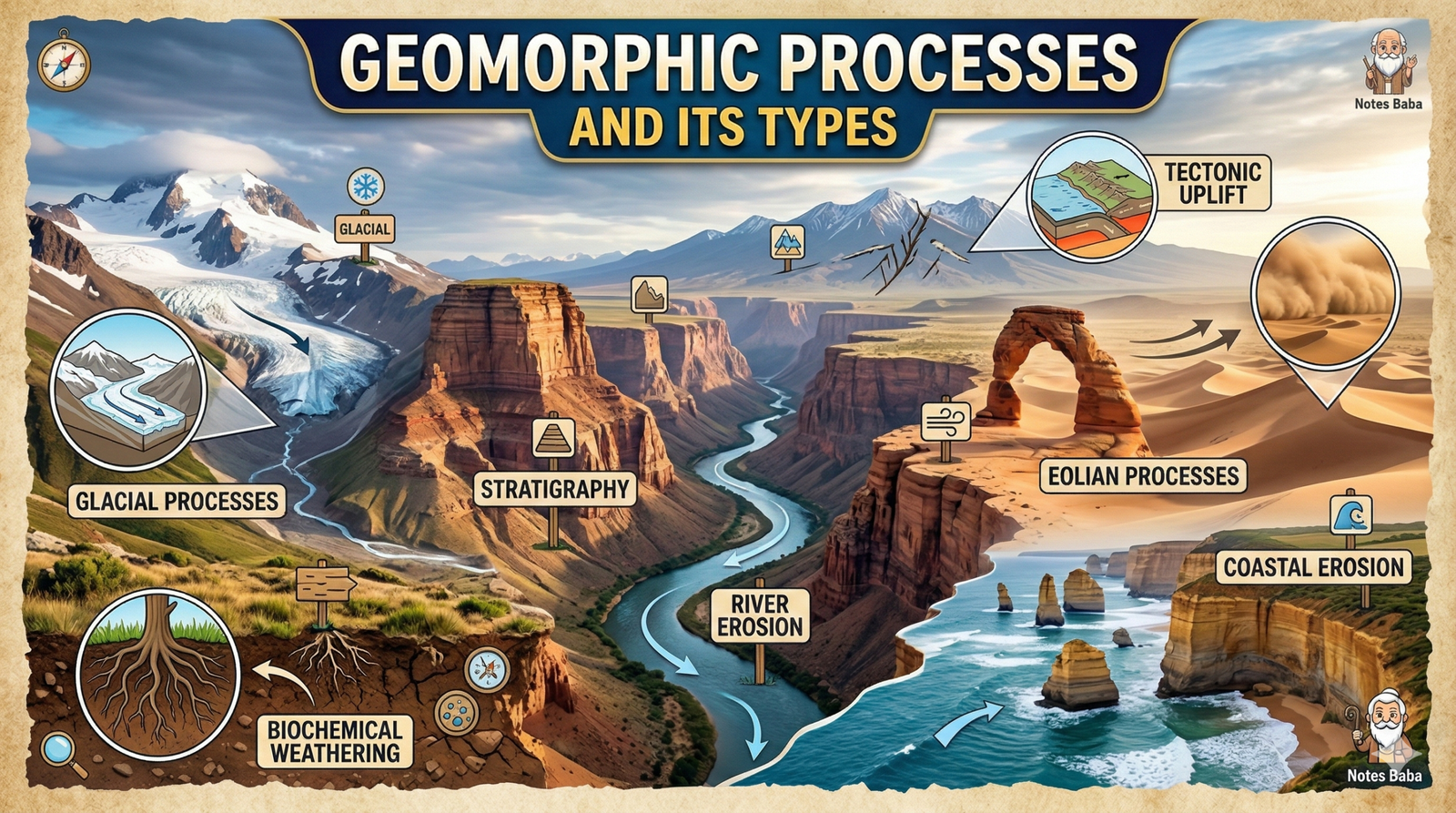

The Physical or Chemical changes brought about the landscape of the earth’s surface is termed as Geomorphic Processes. It is natural mechanism that shapes or alter the earth’s surface over the time.
- Geomorphic word comes from ‘Geomorphism‘. The term ‘Geo’ means earth and ‘morphism’ means change/formation.
- The formation of different forms of structures on the earth is called Geomorphism. It studies the earth crust layer’s movements.
- These processes are driven by the forces both within the earth and at the earth’s sruface.
- Geomorphic agents, such as magma, water, wind, sunlight, bacteria, earthworms, etc. cause these processes.
- Large-scale Physical and Chemical changes occurring on the surface of the earth due to geomorphic agents or geomorphic processes are called Geomorphic Movements.
Types of Geomorphic Processes
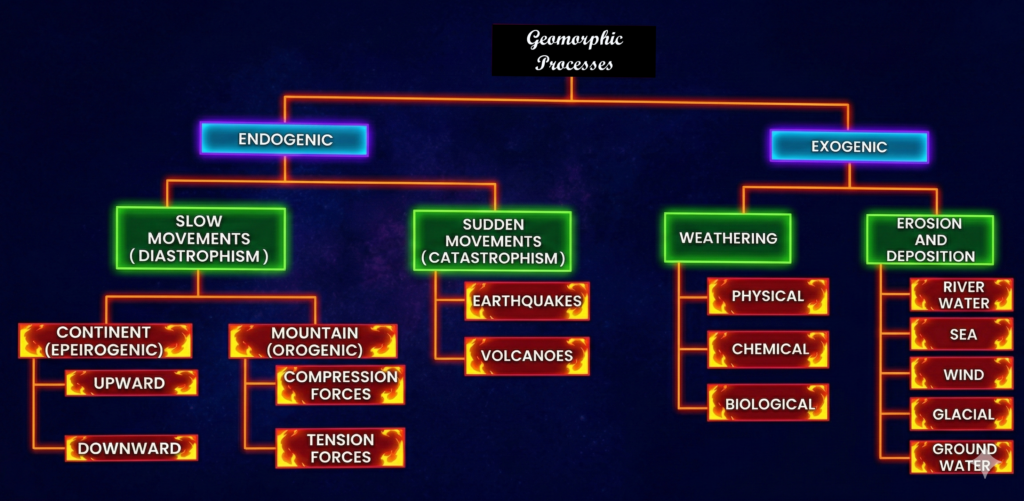
Geomorphic Processes are categorised into two types – Endogenic and Exogenic processes.
Endogenic Processes
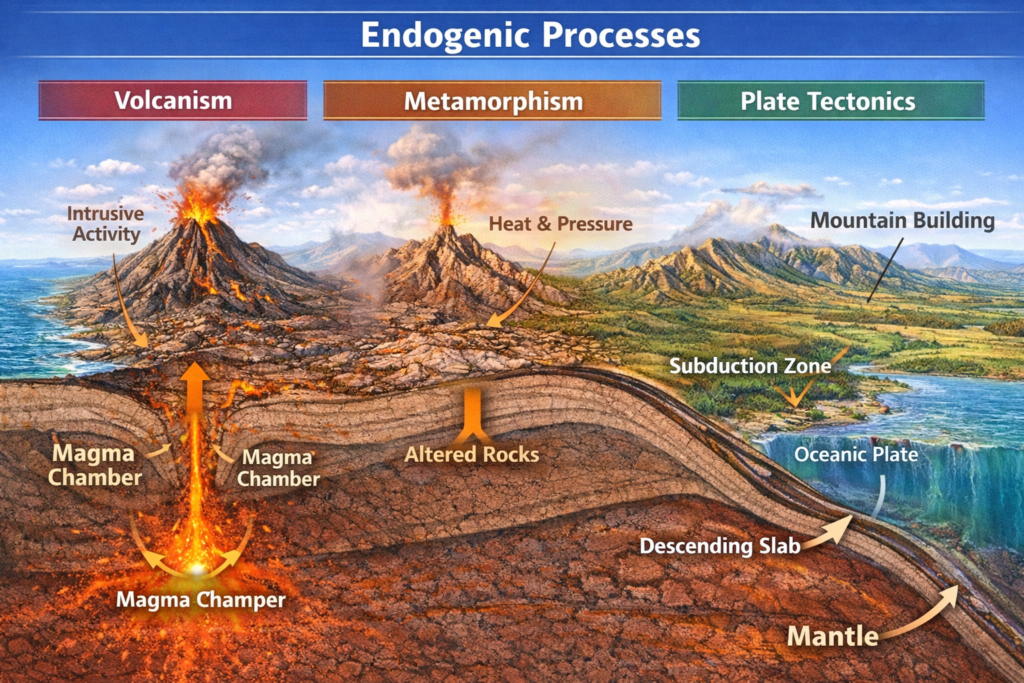
- These are internal forces that originates from within the Earth’s interior.
- Responsible for the movements of the earth.
- Powered by the Earth’s internal heat (radioactive decay, gravitational forces and residual heat).
- Contribute to the upliftment of the landforms.
- Also called as Constructive Forces/Movements.
- Further classified into two types –
- Diastrophism
- Catastrophism
Diastrophism
- Slow movements caused by internal forces.
- Includes all the movements caused by the tectonic force.
- Responsible for the formation of landforms such as Continents, Mountains, Rift Valleys etc.
- Due to its slow process, its effect becomes noticeable over a period of several years.
- Further classified into two processes –
- Epeirogenic Processes
- Orogenic Processes
Epeirogenic Processes
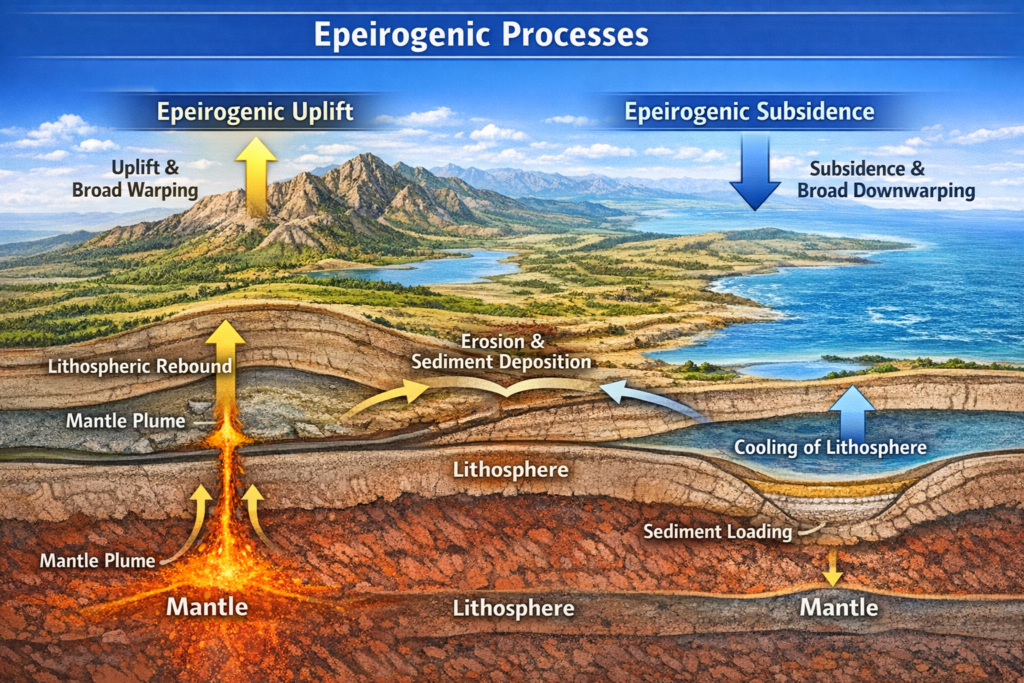
- ‘Epeiro’ means continent and genic means genesis.
- Also known as Radial Movement or Continental or Crustal Movements.
- It is upward (uplift) or downward (subsidence) movement of earth’s crustal plate.
- Occurs due to Vertical force origination from the interior of the earth.
- Responsible for the formation of Continental crust and oceanic crust.
- Leads to the formation of Pleateaus, Plains and Basins.
- It is perpendicular to the surface and acts along the radius of the earth.
- One of the common cause of epeirogenic movements is Isostatic Adjustment.
- Example :- Upliftment of Deccan Plateau.
- Two types of movements under Epeirogenic processes –
- Uplift Movement
- Can be of the whole continent or a part,
- Can be of the coastal land of the continent, it is termed as Emergence.
- Ex – Coromandel Coast, Tamil Nadu, or Malabar Coast, Kerala.
- Downward Movement
- Can be of the whole continent or a part,
- Can be of the coastal land of the continent, it is termed as Submergence.
- Ex – Andaman and Nicobar or Rann of Kutch etc.
- Leads to the formation of landforms such as Ria, Dalmatian etc.
- Uplift Movement
Isostatic Movement
- Isostasy is a state of gravitational equilibrium between the lithosphere and asthenosphere.
- The changes in load such as melting, glaciers, deposition of sediments or erosion can cause the land to uplift or subsidence.
- The high altitude landforms such as Mountains have a great thickness of crust and composed of lighter material as compared to oceanic crust.
Orogenic Processes
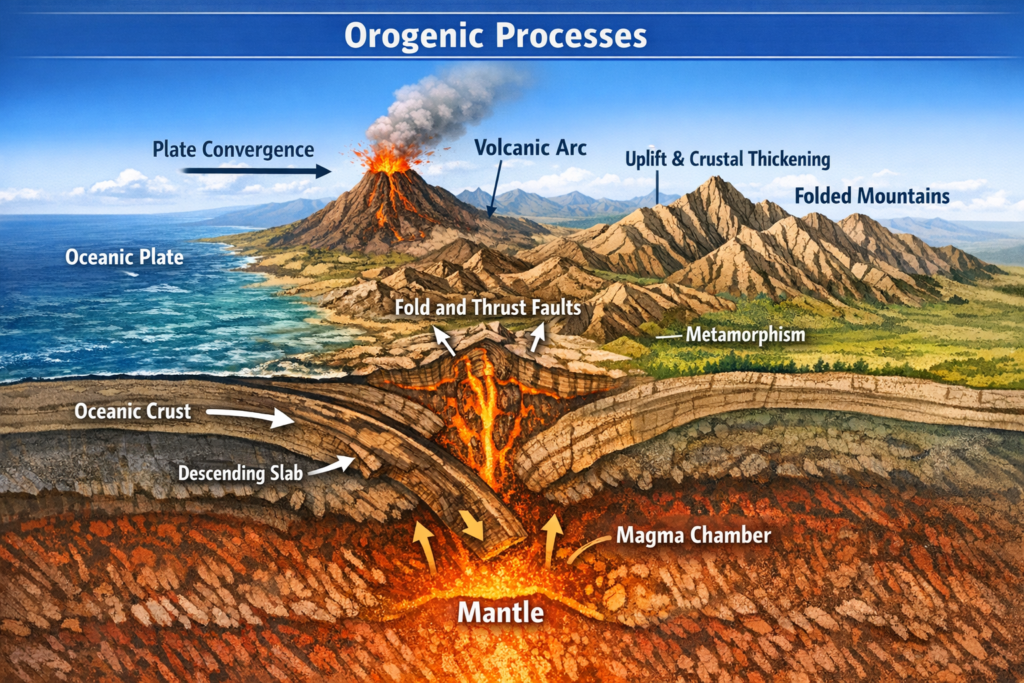
- Oro means mountain and genic means genesis.
- Refers to all the movements of Earth’s crust caused by the internal forces.
- Responsible for the formation of fold and block mountains.
- Orogenic movement includes horizontal compressive forces.
- Plates moving in opposite directions due to divergent or tensional force and are responsible for faults or rifts and block mountains.
- Plates moving towards each other due to convergent or compressional force and are responsible for the formation of fold mountains.
- Orogenic Processes are much more intense than epeirogenic movements.
- Two types of Orogenic processes –
- Tangential (tensile) forces:
- It is a horizontal force.
- It is also known as tangential Forces.
- It works in two opposite directions.
- It leads to the formation of rift valleys, faults, and cracks (fissures).
- When crustal plates move away it applies, Tension force (pulled in opposite directions along its axis, or length).
- Example: Block mountains, Black forest etc.
- Compressional Force:
- It is pushing force.
- It will lead to the formation of folds.
- It can lead to up-warping and down-warping.
- When crustal plates come closer, it applies Compression force (act to push together, or compress, an object).
- Examples of fold mountains: the Rockies (North America), Andes (South America), Himalayas, etc.
- Tangential (tensile) forces:
Catastrophism
- These are quick or sudden earth movements.
- Divided into two parts –
- Volcanism –
- It is the process of the movement of molten rock (magma) toward the earth’s surface.
- It leads to the formation of many intrusive and extrusive volcanic forms due to the pressure generated by the Magma.
- Examples :- Volcanic mountain (Mount Vesuvius, Italy), Volcanic Plateau ( Deccan plateau).
- Earthquakes –
- It is a sudden release of energy in the form of waves due to plate interaction, rock slippage, and human activities (explosion, construction of the reservoir, etc.).
- These waves’ energy shakes the earth’s surface.
- It is destructive in nature and can lead to the formation of rifts, schisms (cracks/splits) and valley formation.
- Volcanism –
Exogenic Processes
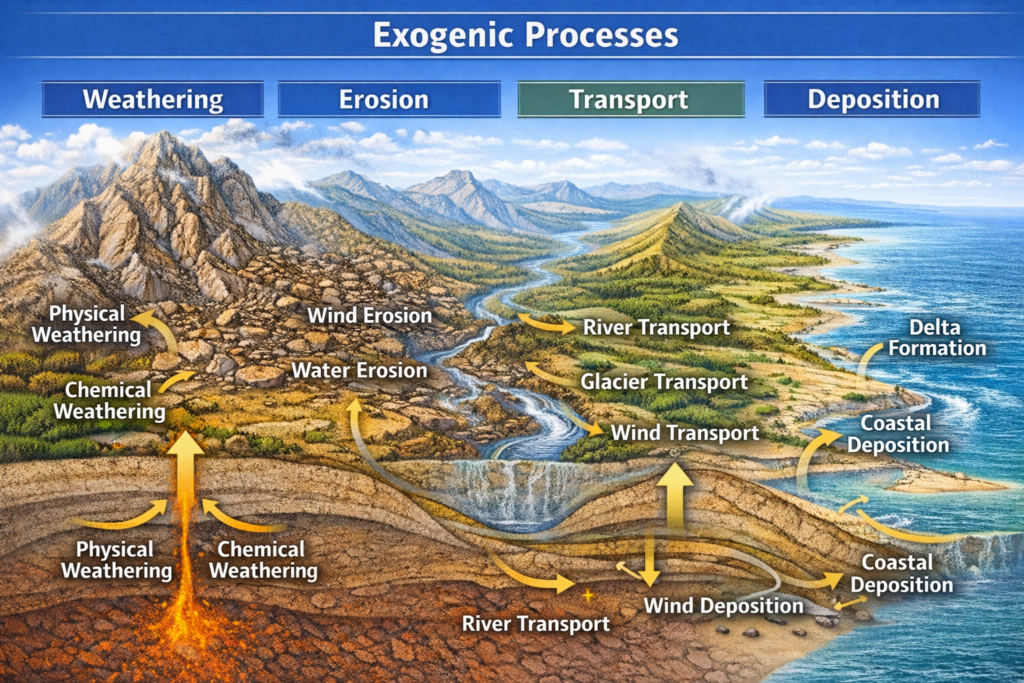
- The geomorphic processes that take place at or near the earth’s surface are called as Exogenic Processes.
- Driven by geomorphic agents such as wind, water, ice, etc.
- Originates from outside the earth’s surface.
- Responsible for the gradual degradation of landforms.
- Also known as Denudational Forces as they strip off the earth’s surface through weathering, mass wasting, erosion and deposition. ‘Denude‘ means to strip off all the exogenic processes. The main factors responsible for denudation are shear stress, stress, temperature and precipitation.
Weathering
- Weathering refers to the disintegration of rocks into smaller particles through physical, chemical and biologcal processes.
- It is static process as it does not involve any motion except falling down under gravity.
- It weakens the rocks and makes them susceptible to erosion.
- It is an in-situ or on-site process.
- There are 3 major weathering processes –
- Physical/Mechanical Weathering
- Biological Weathering
- Chemical Weathering
Physical or Mechanical Weathering
- Mechanical disintegration of rocks or minerals without altering their chemical composition.
- Driven by physical forces such as Gravitational force, change in temp. and pressure, precipitation, drying,etc.
- Key physical weathering processes are as below –
Exfoliation
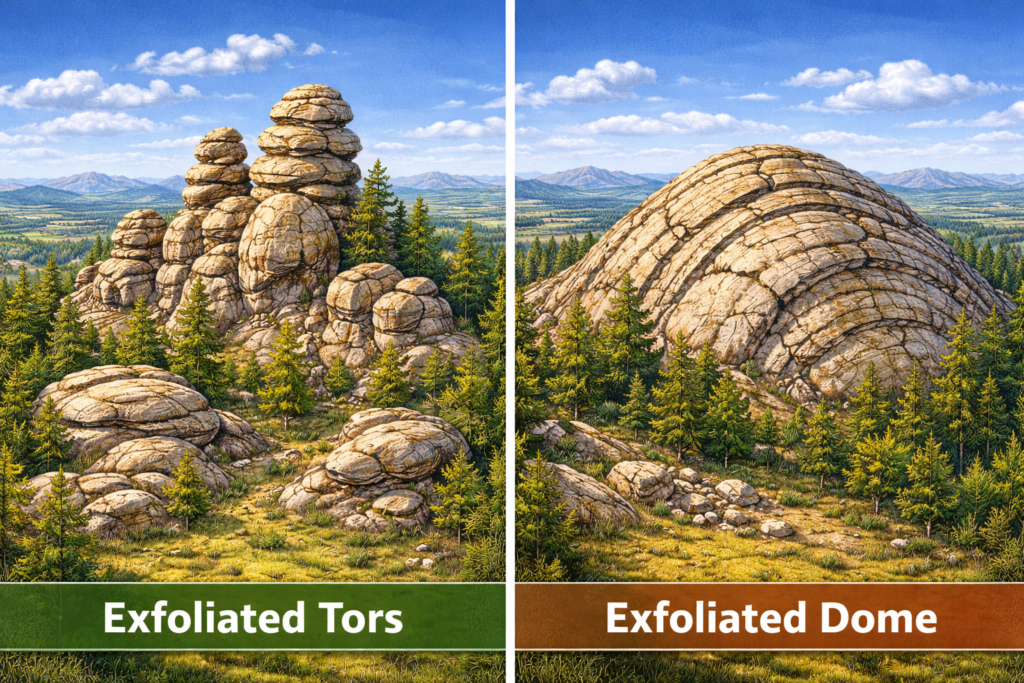
- Occurs when overlying load releases vertical pressure due to continuous erosion. This causes expansion and disintegration within the layers of the rocks.
- This causes removal of upper layer in the form of sheet known as Exfoliation.
- Large and smooth dome shaped disintegrated layers of rocks are called as Exfoliation Domes.
- Also this expansion and contraction result in disintegration and the upper layer separates as a sheet known as Exfoliated Tors.
- This process is more effective in drier climate with high diurnal temp.
Thermal Expansion
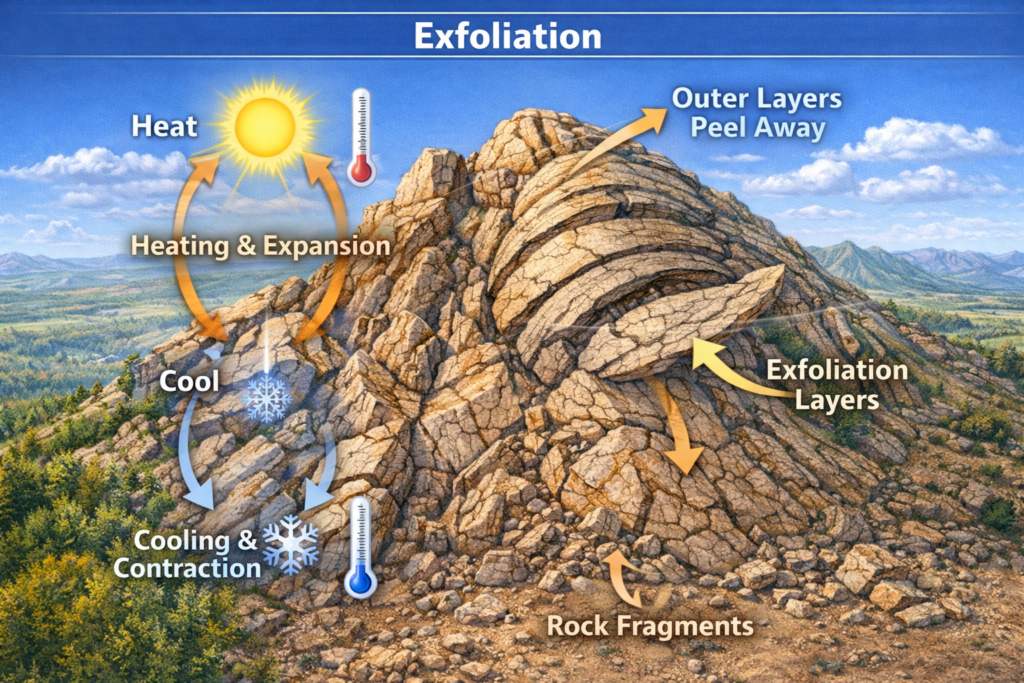
- Occurs when rocks are subjected to rapid heating and cooling (particularly desert environments).
- As the rock heats up during the day, it expands and when it cools at the night, it contracts.
- Thus, these repeated cycles of expansion and contraction causes the outer layers of the rocks to crack down and thus results in the formation of smaller rock fragments.
Frost Wedging
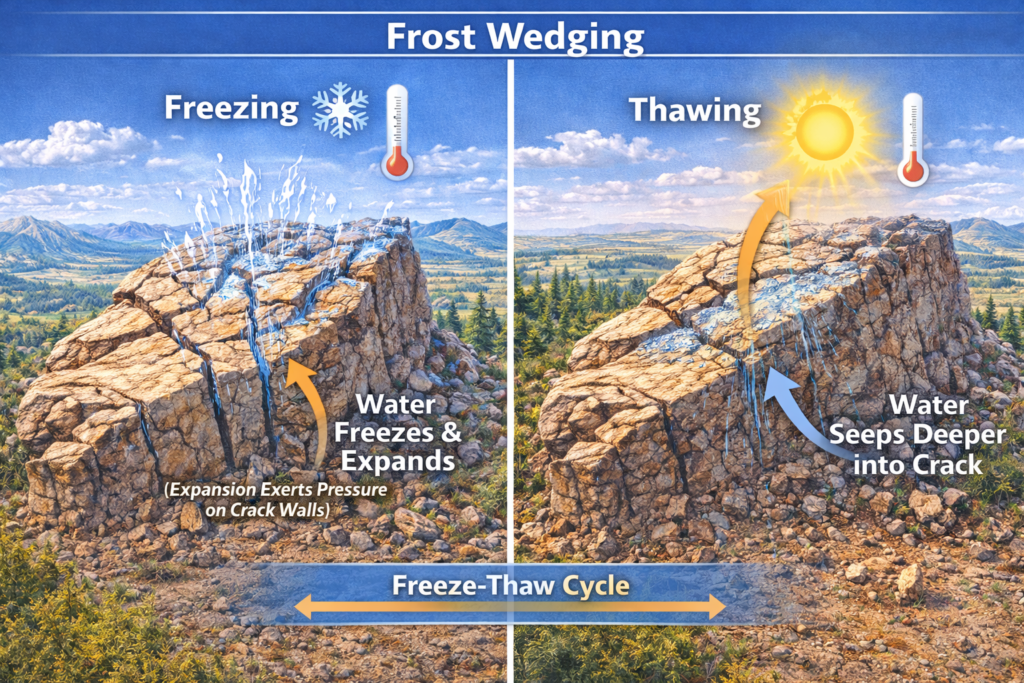
- Also called as Freeze-Thaw Cycle.
- Occurs due to the growth of ice within cracks of rocks during the repeated cycles of freezing and melting.
- During the warm season, the water accumulates in the pores of the rocks while during the cold season, it freezes. On freezing, the volume of water expands and exert pressure on the walls of the rocks.
- With the subsequent warm season, water melts, releasing the pressure. This cyclic melting and freezing results in the tearing of the rocks.
- This cycle also results in the splitting of rocks along the angular joints into blocks.
Abrasion
- Occurs when rocks worn down by friction and collision with other rock particles.
- Happen in rivers, glaciers, deserts or coastal environments where wind, water or ice carries particles that grind against rocks, smoothing and rounding them.
Shattering
- A process of physical weathering whereby a huge rock undergoes disintegration along the weak zone, producing highly angular pieces with sharp edges.
Salt Weathering
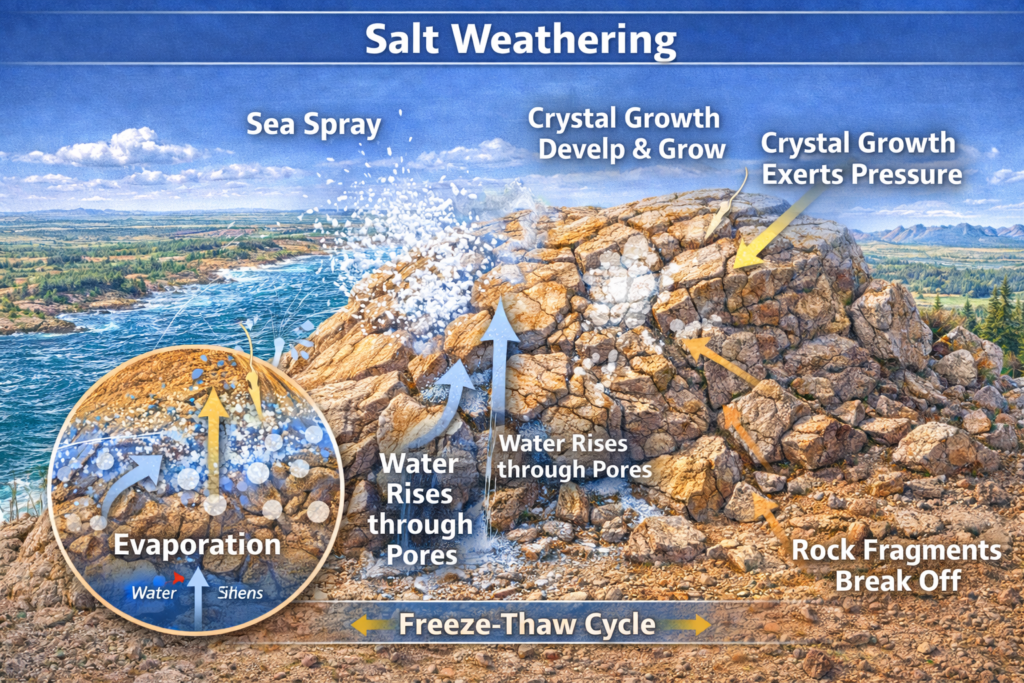
- When salty water enters the cracks of rocks, the water evaporates and salt crystals left behind.
- Salt expands due to thermal action, hydration and crystallization exerting pressure on the rocks and thus breaking the rock into pieces.
- Many salts like Calcium, Sodium, Magnesium, Potassium and barium have tendency to expand depending on their temp. and thermal properties.
Chemical Weathering
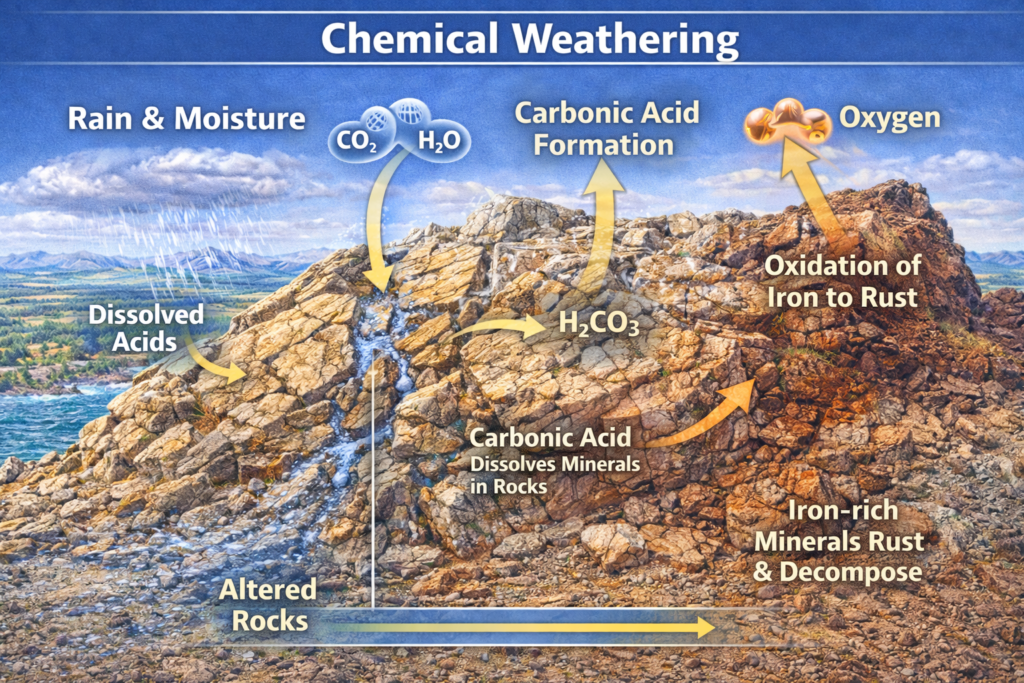
- Alteration of chemical structure of minerals in rock in the presence of water and air, referred to as Chemical Weathering.
- The following are the key chemical weather processes –
Solution
- When something is dissolved in water or acid, then the dissolved content is called Solution.
- In Solution, minerals dissolve directly into the water without any chemical alteration.
- Most effective in high rainfall regions where water moves freely through cracks.
- Due to water reaction, many minerals dissolves in the solution and breakdown and thus, results in the disintegration of rock.
- Example – Gypsum, Halite, Calcium Carbonate etc.
Carbonation
- It is the reaction of carbonate and bicarbonate with minerals and is a common process helping the breaking down of feldspar and carbonate minerals.
- When CO2 from the atmosphere and soil air is absorbed by the water, it forms Carbonic acid.
- This acid dissolves the carbonate materials leading to the breakdown of the rock.
- Responsible for the formation of Karst Topography.
Hydration
- Hydration is the chemical addition of water.
- Minerals takeup water and expand which causes an increase in the volume of material itself on the rock.
- It is reversible process, repeated hydration and dehydration causes disintegration of molecules.
Oxidation and Reduction
- Combination of minerals with oxygen and removal of oxygen is called Oxidation and Reduction.
- This continues addition and removal of oxygen leads to the breakdown of rocks.
Chelation
- Chelates are organic agents mainly composed of peptides and sugar that have ability to decompose minerals and rocks by removal of metallic ions.
- This process of weathering by chelates termed as Chelation.
Biological Weathering
- It is the weakening and subsequent disintegration of rock by plants, animals and microbes.
- Involves both physical and chemical weathering processes.
- Few biological weathering processes –
- Animal activities such as Burrowing and wedgeing by organisms such as earthworms help in exposing new surfaces to chemical attacks and assists in the penetration of moisture and air.
- Human activities such as Ploughing and Cultivation Soil also help in mixing and creating new contacts.
- Decaying plant and animal matters also helps in the production of humic, carbonic and other acids that enhance decay and solubility of some elements.